FAQS
Frequently Asked Questions
Answers for your questions, all in one place.
Just a few of the many FAQs
What is Westlake Securities?
Westlake Securities is an award-winning, top boutique middle-market investment bank headquartered in Austin, Texas. Founded in 2003, the firm has been under the leadership of our CEO, Matt Andersen, and has advised on more than $6.7 billion in transactions over 23+ years, serving more than 400 organizations. We focus exclusively on middle-market companies across M&A advisory, capital raises, and growth strategy.
What services does Westlake Securities offer?
• M&A Advisory: sell-side transactions, buy-side acquisition support, and capital placements
• Capital: growth capital raises, minority recapitalizations, debt advisory, and balance sheet optimization
• Intentional Growth: proprietary advisory framework to help middle-market CEOs build companies with purpose and maximize enterprise value
What size companies does Westlake Securities work with?
Westlake’s core focus is middle-market companies. Over 23 years, we’ve worked with companies of all sizes in the middle market space. What matters more than size is where you are in your journey and what you’re trying to accomplish. If you’re uncertain whether you’re the right fit, the best first step is a conversation.
What industries does Westlake Securities serve?
Westlake has closed transactions across a wide range of industries, including, but not limited to: Manufacturing & Industrials, Consumer Packaged Goods, Food & Beverage, Business Services, Infrastructure Services, Construction Services, Technology & Fintech, Clean Energy, Chemicals, Commercial Real Estate, and Hospitality.
Is Westlake Securities a Licensed Investment Bank?
Yes. Investment Banking Services and Securities are offered through FNEX Capital, LLC, Member of FINRA and SIPC. Westlake Securities is not affiliated with FNEX Capital.
Does Westlake only work with companies based in Texas?
No. While Westlake is headquartered in Austin and has deep roots in the Texas business community, we advise companies across the United States. Our buyer and investor relationships are national and, for many industries, international. Geography doesn’t limit who we serve. Fit and alignment with our approach are what matter.
Is my conversation with Westlake confidential?
Absolutely. Confidentiality is foundational to everything we do. Initial conversations are completely confidential. We do not share information about clients or prospective clients, and we routinely execute NDAs before we share any detailed business information. Your employees, customers, and competitors will not know you’ve spoken with us.
I’m not sure if I’m ready. Is it still worth reaching out?
Yes, especially then. The business owners who get the best outcomes are the ones who start the conversation long before they need to. Whether you’re 18 months from a potential transaction or five years out, an early conversation gives you clarity about what your business is worth today, what it could be worth with deliberate preparation, and exactly what to do between now and then.
Intentional Growth
What is Intentional Growth?
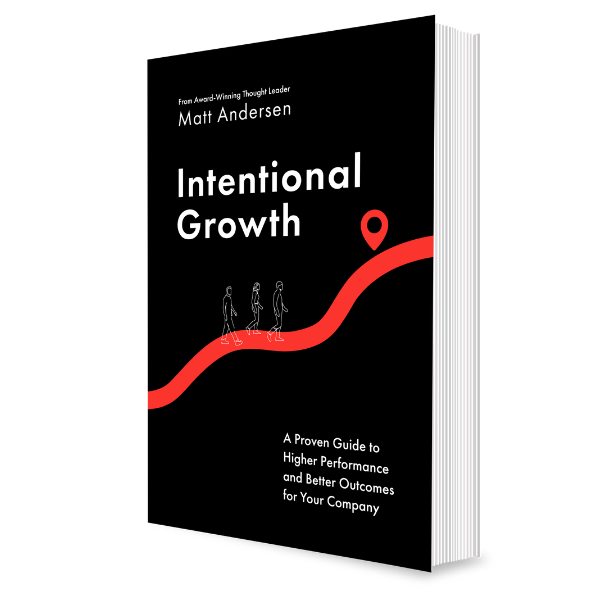
Intentional growth is a disciplined framework for building companies that create lasting value, not just revenue. It was defined by Westlake Securities CEO Matt Andersen to describe what separates great companies from reactive ones: growth that is scaled, professionalized, fast-moving, and sustainable.
Unlike reactive growth, which chases short-term wins and responds to external pressure, intentional growth starts with a clearly defined destination and reverse-engineers every strategy, investment, and decision from there.
How long does an Intentional Growth engagement typically last?
Intentional growth is a multi-year commitment, not a one-time project. Most engagements begin with a discovery phase and growth map, progress through a 100-Day Plan and Year 1 implementation, and continue through ongoing refinement cycles. The length depends on your goals and where you are in your growth journey. Some clients engage for 18 months; others work with us for five or more years.
Do I need to be planning a sale to work with Westlake on growth?
Not at all. Many of our best Intentional Growth clients have no immediate plans to sell. They’re focused on building a stronger, more valuable business for its own sake. The discipline of building as if you might eventually sell simply produces better companies. When and if a liquidity event becomes the right next step, we’re already deeply familiar with your business and can run that process with no ramp-up time.
What is the QVG Assessment?
The Quality Value Growth (QVG) Assessment is Westlake’s proprietary diagnostic framework for evaluating a business across five pillars: Leadership & Management, Business Performance, Industry & Marketplace, Positioning & Branding, and Finance & Accounting. It’s the tool that connects strategy, execution, and value realization. It’s also the basis for the Intentional Growth plan we build with clients.
Selling Your Company
How do I know if my business is ready to sell?
The best first step is an honest conversation about where you stand. We’ll give you a clear-eyed assessment, even if the answer is “not yet, but here’s what to do next.”
How long does a typical M&A process take?
- Days 1-30: Marketing preparation, including financials, CIM, teaser, and buyer list
- Months 2-3: Confidential go-to-market and IOI review
- Months 3-4: Management presentations with shortlisted buyers
- Months 4-5: LOI negotiation and partner selection
- Months 5-8+: Due diligence, legal, and closing
Why do I need an investment banker? Can’t I just sell my business myself?
- A single-buyer negotiation almost always results in a lower price than a competitive process
- Institutional buyers have experienced deal teams. You need one too
- The CIM, positioning narrative, and financial presentation significantly impact perceived value
- Running a sale while running your business is extremely difficult. Distractions in either direction cost you
What is EBITDA and why does it matter for my valuation?
EBITDA stands for Earnings Before Interest, Taxes, Depreciation, and Amortization. It’s the primary profitability metric buyers and investors use to value middle-market businesses, typically expressed as a multiple (e.g., “6x EBITDA”).
Why it matters: a $5M EBITDA business at a 7x multiple is worth $35M. But multiple expansion, moving from 7x to 8x on that same $5M EBITDA, adds another $5M in enterprise value without a dollar of earnings growth. Combine earnings growth and multiple expansion, and the value impact compounds quickly. Understanding how buyers apply multiples, and what drives expansion, is one of the highest-value things we help owners understand.
Capital Placements & Advisory
How do I raise growth capital without selling my company?
- Debt financing: senior bank debt, SBA, or unitranche facilities that fund growth without diluting ownership
- Minority equity: selling a minority stake to a growth equity fund or family office that provides capital and strategic value without taking control
- Mezzanine or subordinated debt: flexible capital that sits between senior debt and equity, often with warrants or PIK interest
Should I sell the whole company or do a partial sale?
It depends on your personal goals, your stage of life, your confidence in future growth, and how much operational involvement you want going forward. A full sale provides complete liquidity and a clean exit. A partial sale (recap or minority investment) provides partial liquidity while keeping you in the driver’s seat for the next chapter of growth.
Many of our clients have done both, completing a recap at one point and a full sale years later when the business had grown substantially. The IPM Foods / NaturPak engagement is a good example: a potential early sale became a multi-year growth plan that created dramatically more value than an early full exit would have.
What is a recapitalization?
Recaps are often the right structure when the business is growing and the owner wants to continue leading it, when the owner wants to diversify personal wealth without a full exit, or when the business needs capital to accelerate growth or make an acquisition.
Interested in exploring growth and/or liquidity options for your company?
Our team is here to help you navigate growth, transitions, and strategic opportunities through tailored advisory services. When the stakes are high, our team brings the experience to move with confidence.